


Hospitals & medical labs
The questions that never reach a person
Most of what arrives at a hospital switchboard or a lab reception is not clinical. It is opening hours, whether to fast, prices, and which department to walk to. The assistant answers all of it from your own documents, and hands your team only the conversations that need a clinician.
Salim
Al Nour Labs assistant
Try it — ask about fasting, opening hours or a price
Voice Mode
Tap the mic and ask about a test
Answers come from the documents this clinic uploaded. Anything clinical is routed to a person.
Your documents, not the internet
It answers from what you upload
Upload doctor lists, price lists, preparation sheets and policies as PDFs, Word documents or spreadsheets. They are indexed and searched by meaning rather than keyword, so a patient asking “do I need to fast for a lipid panel?” finds the right line of your own preparation sheet — not a plausible answer invented from the open web.
Before the visit
Whether to fast, what to bring, how long results take, what a test costs — asked and answered without a phone call.
After the report
Patients can upload a lab report or scan and have it explained in plain language, with anything that needs a clinician routed to one.
Everything else, triaged
Clinical conversations become structured encounters with a priority level, so volume stays visible rather than disappearing into a phone line.
Grounded, not guessed
Every answer points back at your own document
Upload your preparation instructions, price list, panel catalogue and opening hours. The assistant retrieves the relevant passage before it answers, and shows which document it came from — so your team can check it, and it cannot invent a fasting window you never published.
- ✓ Answers in Arabic and English from the same uploaded source
- ✓ Says it does not know rather than guessing
- ✓ Hands off to a human the moment it is clinical
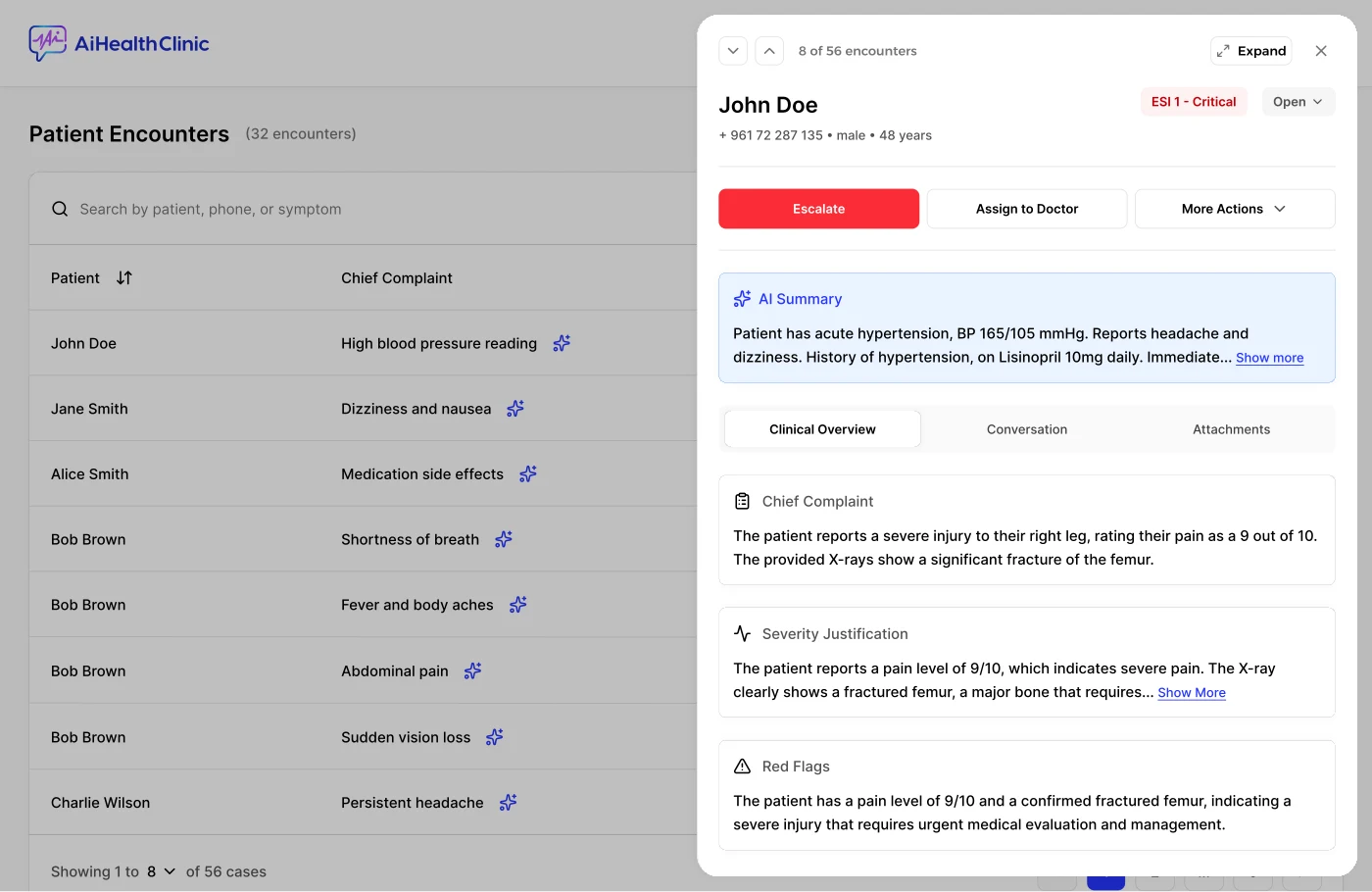
When it is not a question
Clinical conversations land as a written case
The moment a chat stops being about hours or pricing, it becomes an encounter: complaint, urgency, a summary and the full transcript, waiting in the same queue your team already works from.
Wherever the patient starts
One assistant, one queue
The same assistant runs on your website, on WhatsApp, and on a tablet in the waiting room — by text or by voice, in Arabic and English. Wherever a patient starts, it ends as one encounter in one prioritized queue.
The assistant informs and routes; it does not diagnose.